金陵十三钗
Is the rapid growth of China’s emerging industries driven by industrial subsidies?: People’s Daily_我的网站

一 |
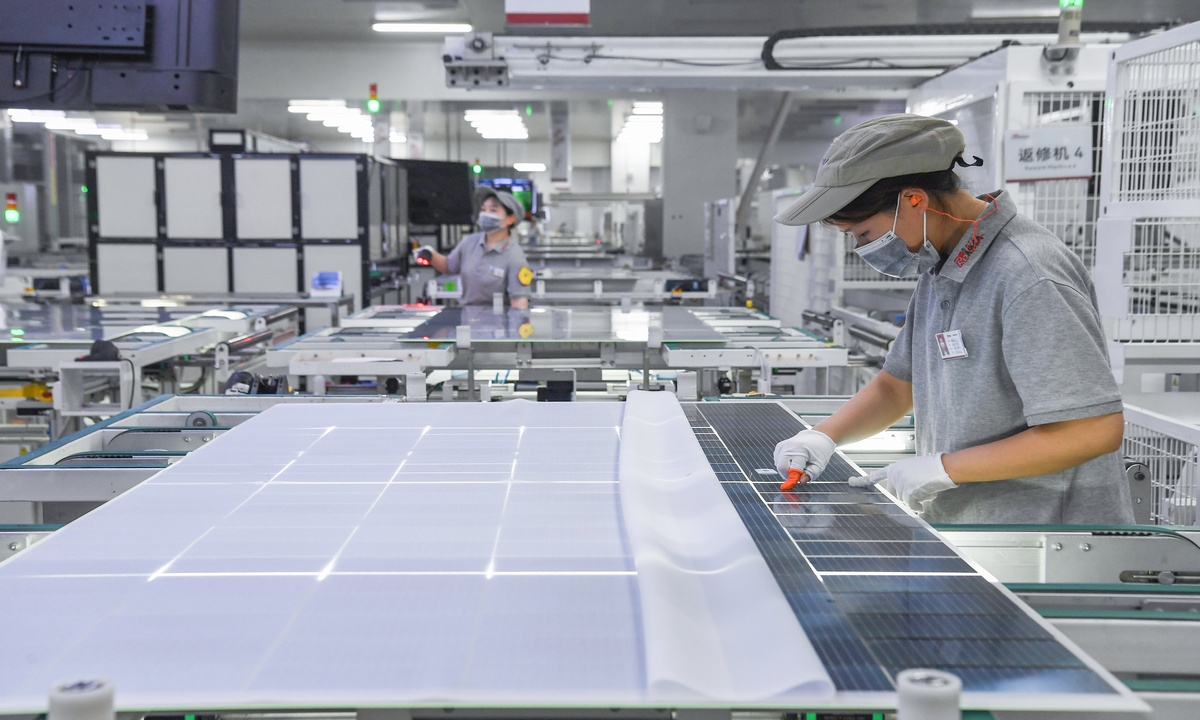
Workers assemble solar photovoltaic modules at a smart manufacturing workshop of Ronma Solar Energy Group in Jindong district of Jinhua city, East China's Zhejiang Province, on July 28, 2026. Photo: VCG
China saw robust exports in electric vehicles (EV), lithium batteries and photovoltaic products, known as the "new three," in the first half of this year. More notably, robotics, artificial intelligence (AI) and innovative drugs, which represent the future direction of industrial development, are also emerging as new calling cards for China's foreign trade.
However, the impressive performance provoked unease among some Western media outlets and politicians. Some have deliberately portrayed China's rapid industrial development and strong competitiveness as a result of government subsidies, pushing the false claim that subsidies have created overcapacity and those low-priced Chinese products are flooding global markets. Such fallacies, which simply equate industrial subsidies with overcapacity, are not only logically flawed but also factually groundless.
In practice, many countries adopt industrial policies tailored to their national conditions and development needs, such as providing research and development (R&D) subsidies for emerging industries and risk related subsidies for agriculture.
Well-designed industrial subsidies can help address market failures, promote technological innovation and environmental protection, reduce poverty and support balanced development, rather than cause so called "overcapacity."
Multiple reports by the United Nations Conference on Trade and Development have noted that the number of industrial policies worldwide has grown rapidly over the past five years, with R&D subsidies, tax incentives and low interest loans for emerging industries becoming common international practices.
Forcibly linking industrial subsidies to "overcapacity" is, in essence, a political manipulation based on double standards. The US, for example, plans to provide $750 billion in various subsidies from 2022 to 2031 under its Inflation Reduction Act. Subsidized EVs are subject to requirements such as production and sales in the US or North America, effectively excluding other WTO members. US industrial subsidies for AI are even greater than those of all other countries combined.
Similarly, according to incomplete statistics, the European Commission is expected to provide more than 1.44 trillion euros ($210 billion) in various subsidies between 2021 and 2030. The EU's Industrial Accelerator Act links local content directly to financial support through "Made in EU" requirements, creating serious investment barriers and institutional discrimination.
Have these massive subsidies been labeled as causing "overcapacity"? The answer is no. While claiming that China's industrial subsidies lead to so-called overcapacity, these countries are themselves providing massive subsidies to their own industries. Such double standards amount to selective accusations targeting China, aimed at politicizing trade and economic issues and weaponizing industrial policy.
At a deeper level, accusations that "China's industrial subsidies cause overcapacity" are merely a pretext, reflecting growing anxiety and fear over the rising competitiveness of Chinese industries.
Looking back at the repeated hype in Western media, the criticism has consistently targeted China's most globally competitive industries, including new-energy vehicles, photovoltaics and power batteries. This exposes the real intention of shifting the blame for their own lagging industrial development onto China while stepping up restrictions against Chinese industries.
China's breakthroughs in these industries have been driven by advances in homegrown technologies, complete industrial and supply chains, and robust market competition, rather than by policy subsidies as some have claimed.
In recent years, China has taken multiple steps to regulate and improve its subsidy policies, from reviewing and correcting inappropriate local subsidies to exploring a unified negative list mechanism for local fiscal subsidies. China applies subsidies equally to all market entities, including foreign invested enterprises, strictly follows WTO rules, and continues to improve the compliance, effectiveness and transparency of its subsidy policies.
Rather than fabricating and hyping baseless claims about subsidies and obsessing over building trade barriers, certain Western media outlets and politicians should focus on addressing their own weaknesses and increasing investment in research and development. They should embrace healthy market competition with an inclusive mindset, promote mutual benefit through greater openness, and win markets and drive progress through genuine innovation.
This was compiled and translated by the Global Times English edition based on an article published in the "Chisu Jinsheng" economic commentary column of the People's Daily on August 10, 2026.。 截至6月30日,城市发展集团(City Developments Limited, 简称CDL)今年上半年归属于母公司所有者的净利润(PATMI)同比增长32%至8780万新元,主要得益于集团在资本回收过程中,成功资产剥离所获收益。
住宅热销新加坡市场持续火热今年上半年,
CDL及其合资企业在新加坡共售出588个住宅单位,总销售额达到12亿新元。销售增长主要得益于推出的执行共管公寓昱丰嘉园(Lumina Grand)项目。截至文告发布前,该项目已售399个单位,占项目总数的78%。今年 4 月,集团的联营公司 Cityview Place Holdings Pte. Ltd. 作为新加坡升涛湾W魅居(The Residences at W Singapore Sentosa Cove)项目的附属业主/所有者,以极具吸引力的价格推出58个单位,并迅速被抢购一空。为满足需求,公司随后加推了更多单位,截至文告发布前,已售出84个单位,占项目总数的41%。

二 | (昱丰嘉园项目设计效果图) 投资物业承租率优于市场平均水平CDL在投资物业方面同样表现出色。集团在新加坡的办公楼资产组合,承租率达到93.0%。其中,集团的旗舰发展项目共和大厦(Republic Plaza)的承租率为 97.0%,城市大厦(City House)和 King's Centre 的承租率则分别达到98.6% 和 100%。此外,集团在新加坡的零售资产组合承租率达到97.6%。

三 | 值得一提的是,正在进行重大资产提升计划(Asset Enhancement Initiative,简称AEI)的城市广场(City Square Mall),即便在改造期间,非AEI影响区域的承租率仍保持在99.5%。目前,集团耗资5000万新元的AEI工程正稳步推进,第一阶段已于2024年5月圆满完成,并以94.0%的承租率重新开业。(城市广场的一层中庭的设计效果图) 酒店业积极复苏澳大拉西亚表现强劲今年上半年,CDL酒店业务中的客房平均收益(RevPAR)同比增长3.0%,达到156.0新元。其增长主要得益于澳大拉西亚(Australasia)地区的强劲表现,因集团在2023年12月收购了布里斯班中央索菲特酒店(Sofitel Brisbane Central),至使RevPAR同比增长30.4%,达到121.9新元。今年5月,集团收购了巴黎歌剧院希尔顿酒店(Hilton Paris Opéra)。

四 | 这家标志性的永久产权酒店需求旺盛,入住率和平均客房价格(ARR)均表现突出,尤其是在2024年巴黎奥运会期间。(巴黎歌剧院希尔顿酒店) 资本管理稳健为未来保驾护航CDL的资金状况保持稳健,截至6月底,集团现金储备达17亿新元,现金和可用剩余授信额度总额为37亿元。这一强大的资本基础,为集团未来的发展提供了强有力保障。
Current article:http://www.chaochangkuanbandangyogeseng.sbs/list_ont1/78c4zy.xlsx
Published on:20:16:27

 喝奶啤会吹出酒驾吗?交警实测:亮灯了 但不算酒驾
 星露谷物语 Switch 2 Physical Edition 这种“圈钱”方式,我心甘情愿买账
 Teachers union in Portland, Oregon, votes to strike over class sizes, pay, lack of resources
 민주당은 '윗선'까지 겨냥…'박완수 선거캠프' 측근 구속 갈림길
 截至2019元,北京东部春节将于0:00收到京西红信封。
 “视频车管所”上线 28项业务云端办
 浙江省博展出《韩熙载夜宴图》,观众将可凌晨逛博物馆,文物部门人员:需提前7天预约,限时逛6分钟
 商务部:跨国公司对华投资呈现“三个转变”