
尸兄
In Lebanon, thousands displaced from border towns by clashes_我的网站

A | TYRE, Lebanon -- More than 4,200 people have been displaced from villages in south Lebanon by clashes on the border with Israel, and local officials said Friday that they are ill-prepared for the much larger exodus that would ensue if the the limited conflict escalates to an all-out war.Some 1,500 of the displaced are staying in three schools in the coastal city of Tyre, about 20 kilometers (12 miles) north of the border.As children ran through the courtyard and women hung out clothes to dry on chairs at one of those schools on Friday, Mortada Mhanna, head of the disaster management unit of the municipalities in the Tyre area, said hundreds of newly displaced people are arriving each day. Some move on to stay with relatives or rent apartments, but others have no place to go besides the makeshift shelter, while Lebanon's cash-strapped government has few resources to offer.“We can make the decision to open a new school (as a shelter), but if the resources are not secured, we’ll have a problem,” Mhanna said. He appealed to international organizations to "give us enough supplies that if the situation evolves, we can at least give people a mattress to sleep on and a blanket.”The Lebanese militant group Hezbollah and allied Palestinian groups in Lebanon have launched daily missile strikes on northern Israel since the outbreak of the latest Israel-Hamas war on Oct. 7, while Israel has responded by shelling border areas in south Lebanon. To date, the clashes have killed at least 22 people in Lebanon, four of them civilians.Sporadic skirmishes continued Friday while a number of airlines canceled flights to Beirut. Countries including the United States, Saudi Arabia and Germany have warned their citizens to leave Lebanon.For many of the displaced, the current tensions bring back memories of the brutal one-month war between Hezbollah and Israel in 2006, during which Israeli bombing leveled large swathes of the villages in south Lebanon and in Beirut's southern suburbs.The tactic of overwhelming force to strike civilian infrastructure as a measure of military deterrence was dubbed the “Dahiyeh Doctrine,” named after the area south of the capital that was targeted.Should another full-blown war erupt between Hezbollah and Israel, “even the city of Tyre will no longer be safe ... because all of the south was subject to bombing” in 2006, Mhanna said.Among the school's temporary residents is Mustafa Tahini, whose house in the border town of Aita al Shaab was destroyed in 2006, along with most of the village. Back then, aid flowed into Lebanon from Qatar and other countries for reconstruction, but this time, Tahini said, “God knows if someone will come to help us.”“I am not a political analyst. I hope things will calm down, but the things you see in the news aren't reassuring,” said Tahini, whose wife and children are staying with relatives in Beirut while he remains closer to home. Still, he said, he is mentally prepared for another war. “We've been through it before.”Sixty-two-year old Nasmieh Srour from the town of Duhaira has been staying in the school with her husband and two daughters for a week, along with many of the village's residents. Like Tahini, she was displaced in 2006; she is also stoic about the prospects of a wider conflict.“Maybe it will get bigger, maybe it will calm down - there’s no way to know," Srour said. Should the displacement become protracted, said Edouard Beigbeder the representative in Lebanon of UNICEF, the U.N. agency for children, said education will be one of the main casualties. Already 52 of the 300 schools in south Lebanon are closed due to the hostilities, leaving more than 8,000 children out of education in addition to those enrolled in the schools that are now being used as shelters, he said. A wider conflict would also threaten key infrastructure including electric supplies and, by extension, water supplies.“In any escalation," Beigbeder said, “it is the most vulnerable and the children who are (left) in dire situation.”。
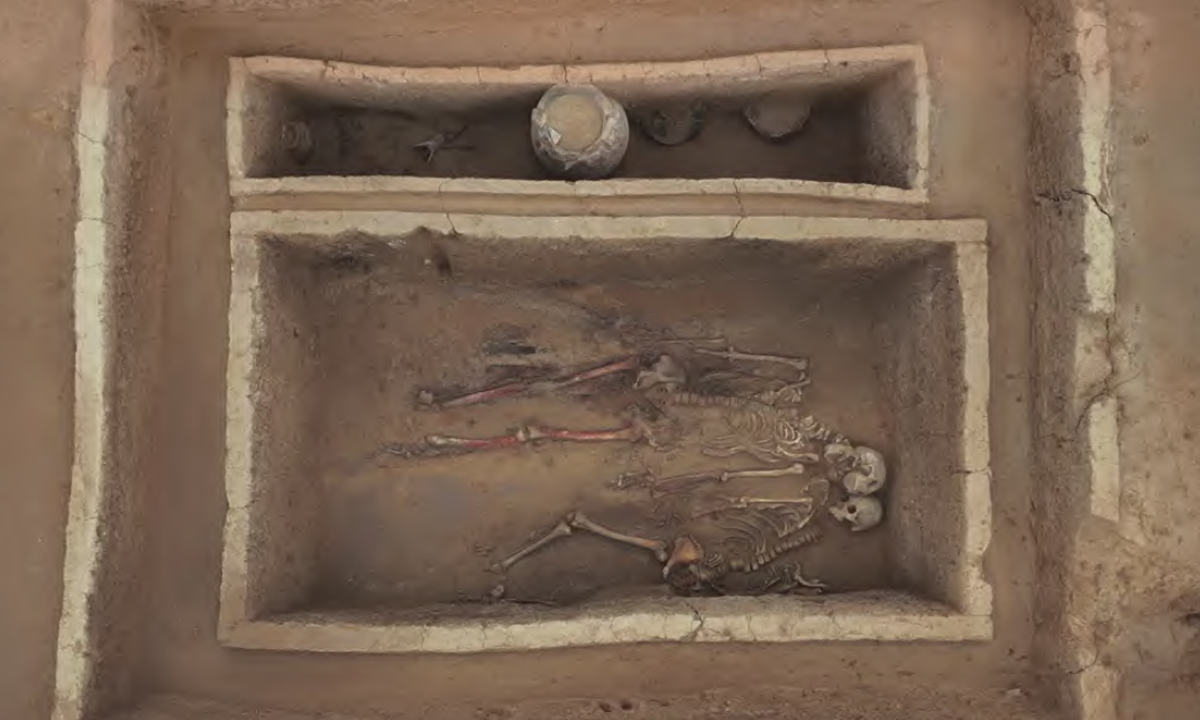
Located on a hilly terrace west of the Taihang Mountains and flanked by the Songxi River, the site was excavated in 2024 and 2025 by the Shanxi Provincial Institute of Archaeology and partner institutions, leading to the discovery of 18 tombs, including six Xia Dynasty burial sites and 12 Warring States Period (475BC-221BC) graves.
"These are the highest-ranking Xia aristocratic tombs discovered so far, indicating that this location was a regional center," the institute said.
The Xia Dynasty is traditionally regarded as China's first hereditary dynasty, though contemporaneous written records are lacking.
The well-organized Xia tombs, concentrated in the western part of the cemetery, feature uniform east-west oriented vertical earthen pits. Researchers recovered nearly 40 sets of artifacts with distinctive local cultural characteristics, including pottery, lacquerware and turquoise ornaments.
Extended regional surveys across the Songxi River valley yielded more than 10 Xia and Shang period sites. Test excavations at nearby relic sites unearthed pottery fragments, stone tools, bronze knives, as well as tin-bronze ingots and smelting residue, providing solid evidence of early metal mining and craftsmanship.
Local copper-iron symbiotic ore deposits confirm exploitation of these resources during the Xia and Shang eras, while typical cultural artifacts found in adjacent counties reveal widespread regional cultural exchange.
Multidisciplinary analyses further decoded the civilization's features. Ancient human remains belong primarily to the ancient population of the Central Plains with minor Mongolian Plateau genetic traits, forming a stable patrilineal clan. The community relied on millet farming and maintained long-distance resource trade networks.
Artifact provenance tests trace scallop shell ornaments to the Bohai Sea, cinnabar to Hunan-Guizhou ore belts, turquoise to the eastern Qinling Mountains area, and coffin timber to local Taihang pine trees. Such diverse materials reflect close interaction among the Taihang foothills, the press release noted.
Lab restoration unveiled refined ritual relics, including a dragon-patterned lacquer cylinder with red and black stripes and an intact lacquer gu vessel (a type of wine vessel). Turquoise plaques from the site match specimens from the Erlitou site, a core Xia cultural relic, proving cross-regional cultural interaction. Radiocarbon dating places the site's active period between 1880BC and 1450BC, aligning with the late Xia Dynasty.
Scholars confirmed the findings have helped reshape academic understanding of Xia-Shang civilizations and reconstruct multi-level settlement patterns on the western Taihang foothills, while offering new insights into social complexity and civilization development in early China.
。
Current article:http://www.chaochangkuanbandangyogeseng.sbs/4ofa6rd/47pob7.html
Published on:12:56:40